There is a reason investors are suddenly paying attention to composite manufacturing.
Layup Parts, a Huntington Beach startup founded by former Anduril engineer Zack Eakin, has raised more than $50 million across a $9 million seed round and a $42 million Series A. Its pitch is simple, sharp and very timely: make custom composite parts as easy to source as CNC parts became through InstaWerk, Xometry and other digital manufacturing platforms.
That is not just a startup story. It is a signal to the entire composites industry.
Composite manufacturing has always sat in a strange place. Everyone wants what composites can do: high stiffness, low weight, fatigue resistance, corrosion resistance, complex geometries and performance that metals often cannot match. Customers come from aerospace, defense, motorsport, drones, EVs, medical technology, sports equipment, robotics, industrial machinery and energy systems. They want lighter structures, faster development cycles and parts that survive demanding real-world use.
But the way many composite parts are quoted, planned and manufactured still feels surprisingly analog. A customer sends a CAD file, a drawing, a laminate requirement or a rough idea. Someone has to interpret the geometry, think about tooling, define materials, understand fiber orientation, estimate layup time, plan curing, trimming, bonding, inserts, QA and documentation. Then the real work begins: who has capacity, which mold is available, which material batch can be used, who knows this exact process, which technician has done something similar before?
This is not ordinary manufacturing. Composite parts are not just machined from a block. They are built layer by layer, with material behavior, process discipline and operator expertise tightly coupled. The difference between a good part and a failed part may be hidden in fiber angle, resin content, out-time, curing history, debulking discipline or a small deviation during layup.
That is why the industry has such a low tolerance for error. In aerospace and defense, there is often no practical room for “almost right.” A process deviation is not an inconvenience. It can become a scrap event, a delivery delay, a certification issue or a safety concern.
At the same time, the hardware world is accelerating. Aerospace startups, drone companies, defense innovators and advanced mobility teams are being pushed to develop faster, iterate faster and ship faster. The old cadence of waiting days for a quote, weeks for planning and months for first parts no longer fits the market. Hardware teams increasingly need what software teams already take for granted: a connected operating layer, instant feedback, traceability, version control and a digital thread from request to delivery.
This is why the Layup Parts story matters. Layup did not raise more than $50 million because investors suddenly discovered carbon fiber. Investors know composites are important. What they are betting on is the idea that composite manufacturing can become faster, more structured and more software-defined.
In 2024, TechCrunch reported that Layup Parts was founded by Zack Eakin, Hanno Kappen and Elisa Suarez, who met at The Boring Company. Eakin later joined Anduril, where he worked on mechanical engineering for drone products. His pain point was straightforward: other manufacturing verticals had become easier to source, while composites still lacked a modern digital procurement and production layer.
The comparison is obvious. CNC machining got instant quoting. Sheet metal got digital workflows. Injection molding got smoother ordering experiences. But composite manufacturing, despite being critical to aerospace and defense, often remained dependent on email chains, spreadsheets, expert memory and manual estimation.
Layup’s answer is to build a new composite manufacturing company around software from day one. Its portal lets customers upload a surface model, configure material and ply information, receive interactive quotes and get parts with QC data, cure logs and out-life tracking available in the portal. Its public positioning is about speed: turning months into days and delivering parts before competitors even return a quote.
The investment case is easy to understand. In the U.S. and Europe, industrial capacity has become a strategic topic again. Aerospace and defense supply chains are under pressure. Skilled labor is scarce. Experienced technicians are retiring. Too much process knowledge still lives in the heads of individual experts. That “tribal knowledge” has always been valuable, but it becomes a bottleneck when companies need to scale, qualify new people and deliver faster without sacrificing quality.
Layup is attacking exactly that bottleneck. It is saying: put the process into software, standardize what can be standardized, keep humans where judgment matters, and make the system fast enough for modern hardware teams.
That is a good thesis. The friendly nudge to the rest of the industry is this: you do not need to raise $50 million to start operating this way. You can do it with compositeOS.
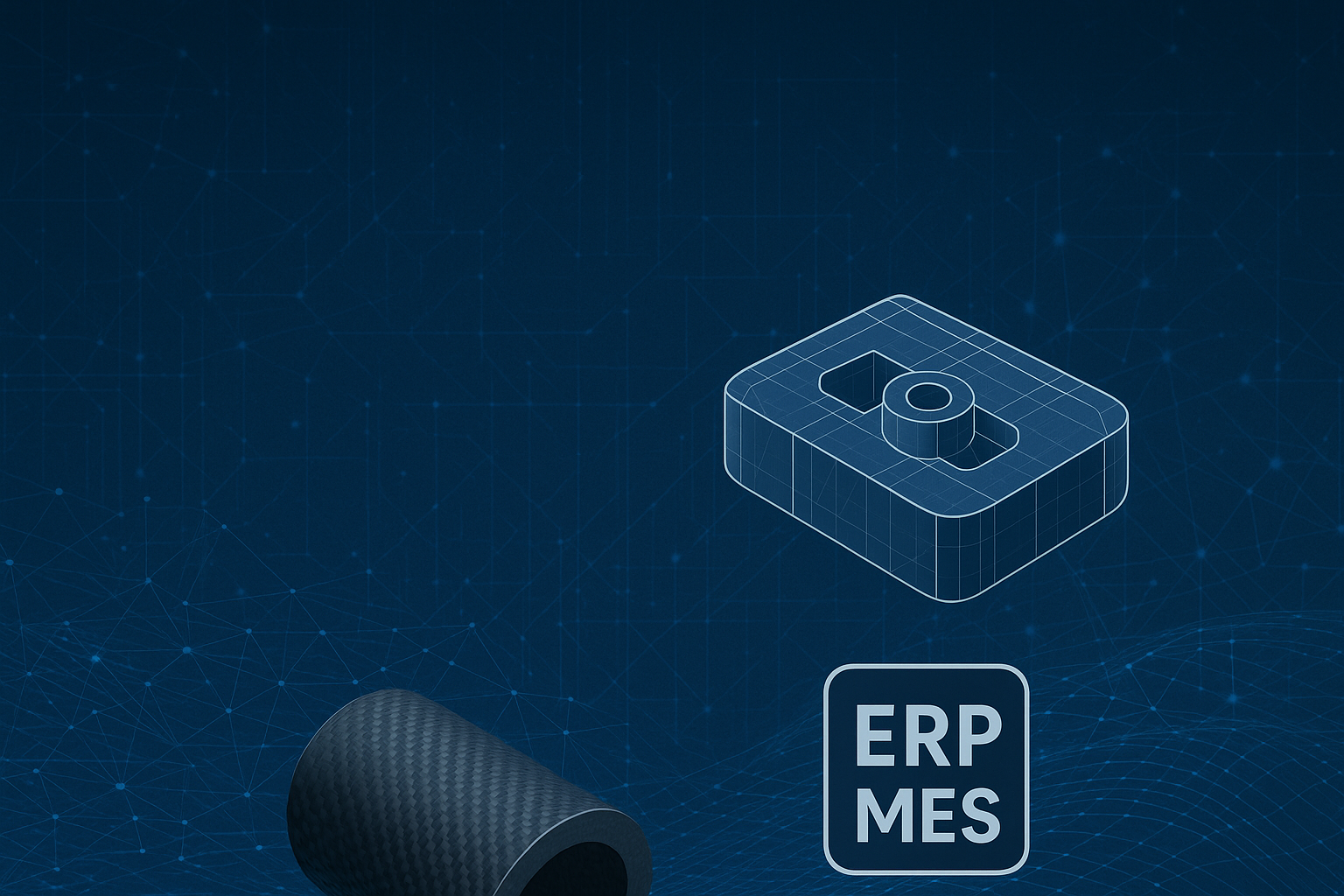
compositeOS is built around the same core insight: composite manufacturers do not need another generic ERP or MES system that treats composites like any other production process. They need a vertical operating system that understands quoting, planning, shop floor execution, traceability and customer communication in the context of fiber-reinforced materials.
The software layer that Layup is building into its own business model is exactly the kind of layer compositeOS brings to existing composite manufacturers.
The first module is Quoting.
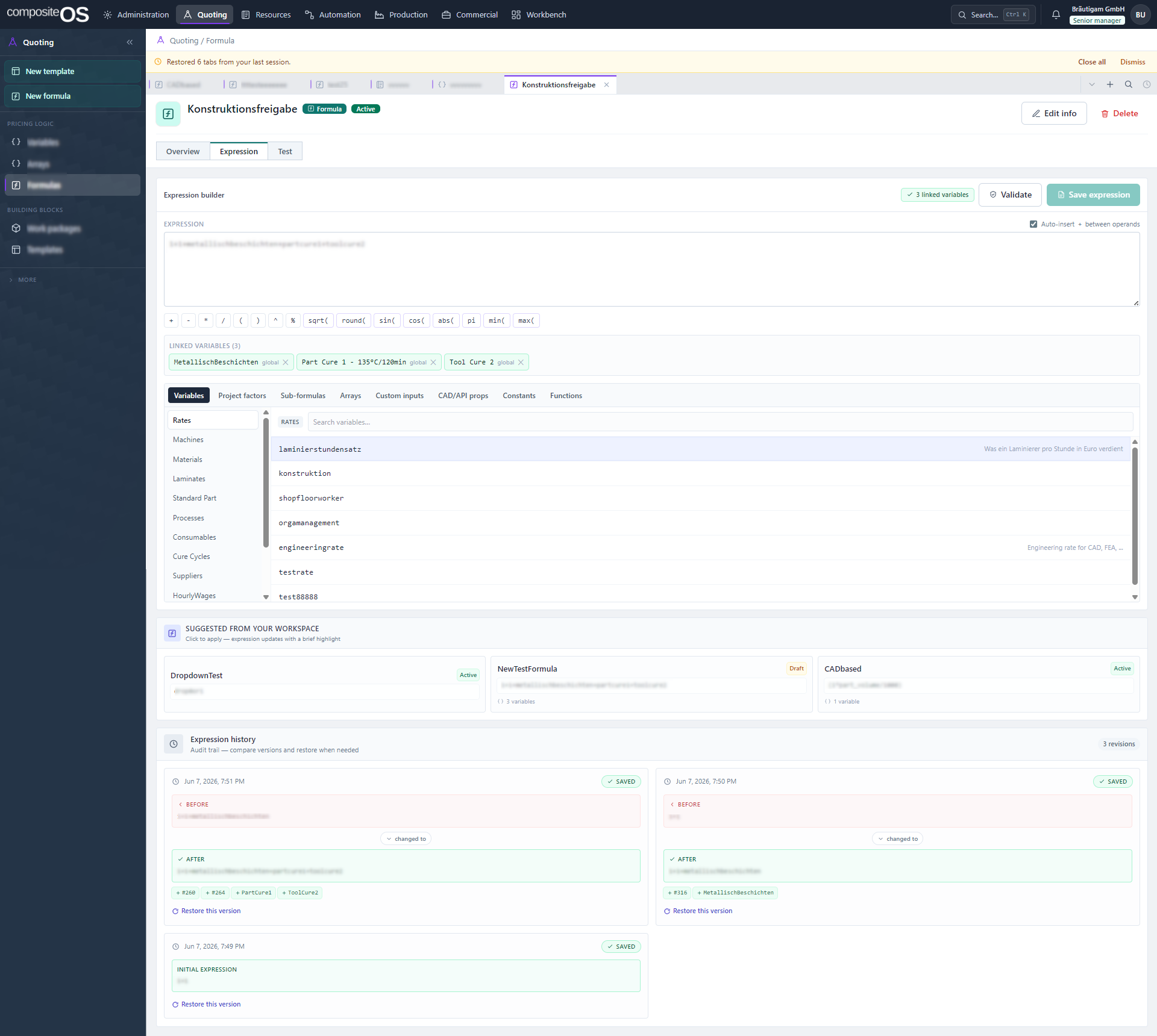
Composite quotes are difficult because they combine geometry, laminate complexity, tooling logic, labor time, material cost, process routing and risk. compositeOS is designed to make this faster and more repeatable. CAD files, ply books, templates and customer-specific calculation logic can be used to create structured proposals in minutes instead of days. The goal is not to replace engineering judgment. The goal is to remove the repetitive work around it, so expert time is spent where it actually creates value.
The second module is Scheduling.
Once a job is won, most composite manufacturers face a planning puzzle. Autoclaves, ovens, molds, clean rooms, cutting tables, CNC trimming, inspection equipment and skilled operators all become constraints. A small change in one project can disturb the entire schedule.
compositeOS turns this into a dynamic planning environment. Projects can be imported from the quoting workflow, broken into process steps and scheduled against available resources. Teams can use templates, drag-and-drop planning and automatic rescheduling to understand the impact of changes before they become shop floor chaos.
The third module is Tracking.
This is where the digital thread becomes real. Operators need clear tasks. Managers need status visibility. Customers need confidence. Quality teams need traceability. compositeOS connects work orders, plybook information, teams, resources, deadlines and progress tracking in one environment. From layup to curing, from trimming to inspection, the system is built for the actual flow of composite production.
The fourth module is Reporting.
Composite production generates valuable data, but too often it disappears into paper travelers, local files or individual spreadsheets. compositeOS creates dashboards and reporting structures for production status, quality metrics, resource utilization and customer visibility. This helps manufacturers understand not just what happened, but where time, margin and reliability are being lost.
The fifth advantage is Customization.
This matters more in composites than almost anywhere else. Every manufacturer has a special process, a special resource, a special curing logic, a special customer format or a special way of organizing laminate data. Generic software usually breaks at exactly this point. compositeOS is designed as an out-of-the-box (here, we should say: out-of-autoclave) solution for composite manufacturers, but with the ability to adapt to the process reality of each company. That is the key difference.
Layup Parts is building a software-defined composite manufacturing company. compositeOS lets existing composite manufacturers become software-defined without rebuilding the entire company from scratch. And this is not software imagined in isolation.
The technology stack behind compositeOS comes from InstaWerk, one of Europe’s leading procurement platforms for CNC-machined parts. InstaWerk has already built and operated the kind of digital manufacturing infrastructure that Layup itself references when it points to on-demand manufacturing platforms: instant quoting, CAD-driven calculation, supplier matching, production monitoring, quality control and logistics.
A lot of industrial software looks convincing in a demo and then collapses when it touches real production. Manufacturing data is messy. Customer files are inconsistent. Lead times change. Suppliers behave differently. Quality requirements vary. Engineers want flexibility. Buyers want speed. Operators want clarity. Management wants control. InstaWerk’s software has lived in that environment every day since 2018. It has been tested not as a slide deck, but as operating infrastructure for real manufacturing workflows. compositeOS brings that platform DNA into composites.
But software alone is not enough. Composite manufacturing requires domain knowledge. That is why the composite expertise behind compositeOS is just as important as the code. The team around CIKONI works on compositeOS with deep experience in CFRP engineering, simulation, testing and automation. CIKONI has worked across automotive, aerospace, mechanical engineering and advanced industrial applications, with a focus on bringing composite structures from concept to manufacturable process.
That combination is rare: manufacturing platform software from InstaWerk, composite engineering depth from CIKONI and a product built specifically for the operational problems of composite manufacturers. This is why compositeOS is not just “ERP for composites.” It is an operating backbone for companies that want to quote faster, plan better, execute with more transparency and preserve process knowledge before it disappears.
And it can be rolled out without venture-scale spending. For a few hundred dollars per month, composite manufacturers can start building the same type of digital thread that investors are now rewarding in companies like Layup Parts. Not in theory. Not in five years. Not after building a full software team. But with modules that address the core operational pain points today: quoting, scheduling, tracking, reporting, traceability and customer visibility.
This is not a critique of Layup. Quite the opposite. Layup Parts is doing the industry a favor by making the opportunity visible. It shows that speed, software and structured composite workflows are no longer nice-to-have improvements. They are becoming the new competitive baseline. The message to existing composite manufacturers is simple: customers want the Layup experience. Investors are betting on the Layup experience. Engineers are tired of waiting for the old process. Procurement teams want transparency. Aerospace and defense programs need reliable capacity. The market is telling us where it wants to go.
So go there. Use what already exists. Digitize the quoting process. Capture expert knowledge. Build a real production schedule. Give operators clear tasks. Give customers visibility. Connect CAD, plybook, resources, quality and delivery into one digital thread. You do not have to reinvent the world to become more digital. Sometimes the easiest move is the smartest one: take the tools that are already here, put them into your company, and start operating like the future of composite manufacturing has already arrived. Reach out to info@compositeos.com to learn more.